THE MATERIAL
The material behind the difference.
Ceritella combines structure-preserving cotton preparation with purposeful yarn, construction and finishing choices. The platform develops natural cotton softness and mechanical stretch and recovery without added softeners or elastomers, with performance specified and evaluated by construction.

One platform. Distinct material experiences.
Ceritella fabric families bring the platform into focus around different product needs. Each construction is developed to its intended material experience and performance specification.
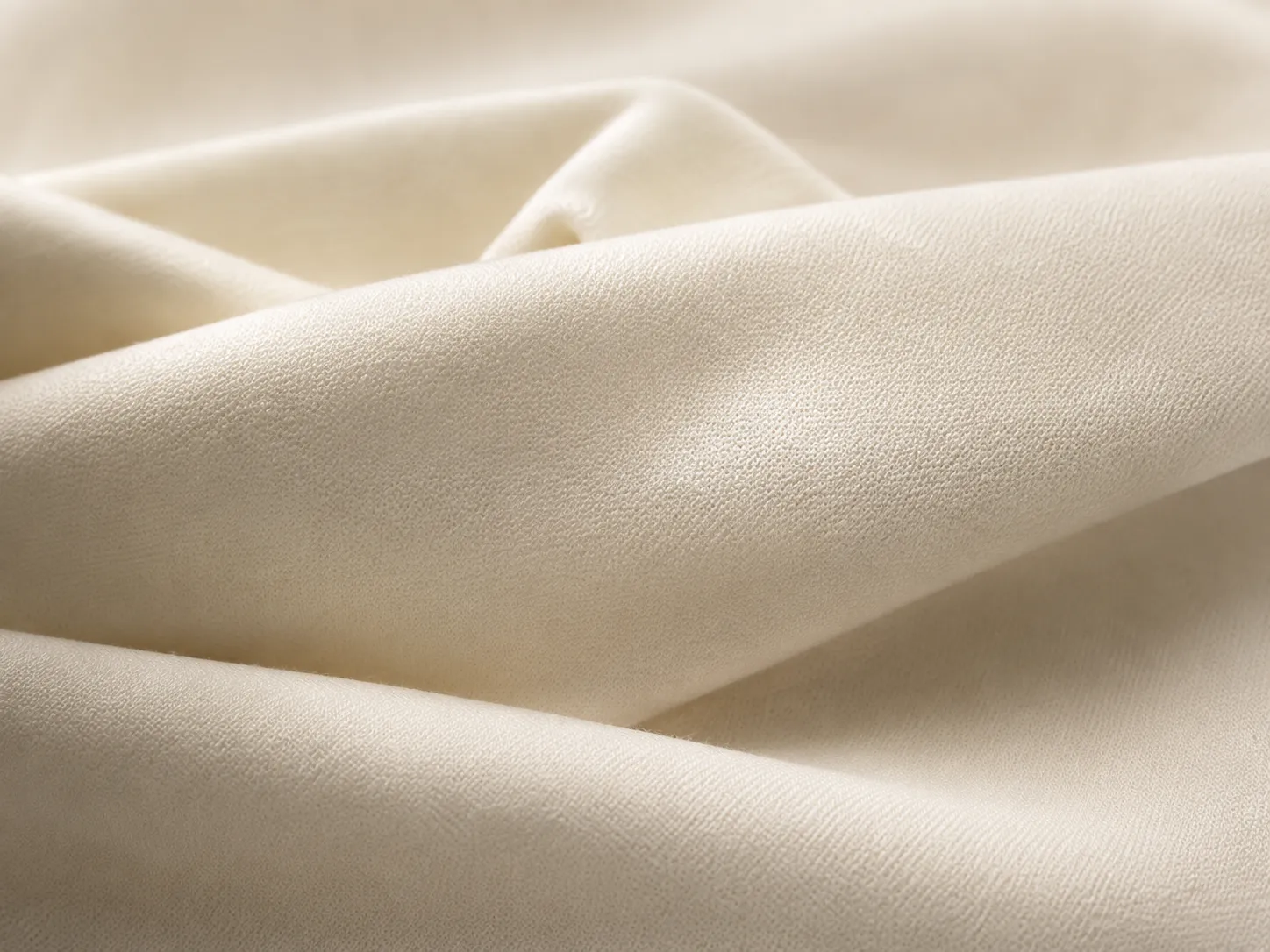
Ceritella Native
Natural softness. No added softeners.
100% cotton, developed for a supple, inviting handfeel without a chemical softening finish.
Explore Native
Ceritella Comfort
In development
Draft focus: stretch and recovery
Draft description to be written.
Explore Comfort
Ceritella Climate
In development
Draft focus: moisture behavior
Draft description to be written.
Explore ClimatePerformance begins with structure.
Cotton’s behavior reflects both its native fiber architecture and the way it is developed into fabric. Ceritella begins with preparation designed to preserve more of that architecture, then builds upon it through material engineering.
FIBER CROSS-SECTION
Dashed box: the outer layers shown enlarged.
OUTER LAYERS, ENLARGED
Cuticle
Thin outermost layer containing waxes and other non-cellulosic material.
Primary cell wall
Thin cellulose wall. With the cuticle, it holds most of the fiber’s non-cellulosic components.
Winding layer
Transitional layer covering the secondary wall, similar to it in structure.
Secondary cell wall
Almost entirely cellulose, built in layers. Most of the fiber.
Lumen
Central canal remaining from the living fiber cell.
Schematic illustration. Not to scale.
Layer descriptions after Boykin, J.C. (2005), “A review of the structure of the cotton fiber,” Proceedings of the Beltwide Cotton Conferences, USDA-ARS.

Raw cotton
Scoured cotton
Published microscopy illustrates changes in cotton’s surface architecture following conventional scouring. These are literature images, not a comparison of Ceritella production samples.
Scanning electron micrographs cropped from Figure 5 of Salem, R.T.A., Thompson, K. and Uttamlal, M. (2022), “Bleaching cotton in textile conservation: a closer look using atomic force microscopy,” Heritage Science 10, 195. doi.org/10.1186/s40494-022-00830-2. Licensed under CC BY 4.0 (creativecommons.org/licenses/by/4.0). Cropped from the original figure; no other changes.
Preservation is the foundation. Engineering is the innovation.
No single input defines Ceritella. The finished material emerges from coordinated decisions about cotton, yarn, construction, processing and mechanical finishing.
These decisions shape the intended handfeel, movement, dimensional stability and other properties of each construction. Verification assesses the finished fabric against the claims made for it.
01
Cotton selection
Aligned with the target material experience.
02
Yarn engineering
Establishes the fabric’s foundation.
03
Fabric construction
Shapes handfeel, movement and stability.
04
Controlled processing and mechanical finishing
Carries the intended material character through development.
05
Verification
Evaluates construction-specific properties.
Measured material behavior.
Ceritella development combines instrumental testing, laboratory evaluation and mill-scale assessment. Results are presented by study so the construction, comparison and test conditions remain clear.
Results from separate comparative evaluations. Findings describe the tested samples and are not automatic claims for every Ceritella construction or fabric family.
A · Controlled cotton-interlock comparisonExtensibility, friction, airflow, strength
| Measurement | Method | Conventional | Ceritella |
|---|---|---|---|
| Length extensibility at 10 lbf | ASTM D4964 | Approx. 36% | Approx. 46% |
| Dry coefficient of friction | ASTM D1894 | Approx. 0.23 | Approx. 0.14 |
| Wet coefficient of friction | ASTM D1894 | Approx. 0.28 | Approx. 0.10 |
| Air permeability, after three washes | ASTM D737 | Approx. 74.5 | Approx. 89.3 |
| Bursting strength | ASTM D6797 | Approx. 101.7 lbf | Approx. 113.1 lbf |
One lot of each fabric. Friction was measured between the fabric and the test surface, not skin. Values are approximate as reported in the Ceritella Performance Validation summary.
B · Instrumental handfeel evaluationemtec Tactile Sensation Analyzer
| Measurement | What it indicates | Conventional | Ceritella |
|---|---|---|---|
| Surface-softness indicator, TS7 | Lower indicates a softer surface | 8.456 | 7.090 |
| Flexibility, D | Higher indicates a more flexible fabric | 3.26 mm/N | 3.90 mm/N |
| Hysteresis, H | Energy lost during deformation | 368 µJ | 211 µJ |
| Recovery, R | Higher indicates fuller recovery | 72% | 80% |
One reading per fabric. Recovery rose by 8 percentage points. This is a separate evaluation from Study A, on a different fabric.
C · Performance through launderingInitial, 10 and 20 washes
| Measurement | Method | Initial | 10 washes | 20 washes |
|---|---|---|---|---|
| Bursting strength | ASTM D3786 | 104 PSI | 101 PSI | 101 PSI |
| Elongation at 10 lb, width | ASTM D4964 | 134.4% | 80.5% | 74.3% |
| Elongation at 10 lb, length | ASTM D4964 | 31.9% | 28.2% | 27.8% |
| Dimensional change, length | AATCC TM135 | Not applicable | -4.9% | -7.5% |
| Dimensional change, width | AATCC TM135 | Not applicable | +4.3% | +4.6% |
| Color change, grey scale | AATCC 135 appearance | Not applicable | 4 | 4 |
| Pilling | AATCC 135 appearance | Not applicable | None observed | None observed |
| Spirality | AATCC TM179 | Not applicable | 1.4% | 2.4% |
One sample, single examination. Bursting strength retained about 97% of its initial value after 20 washes. Elongation fell and the fabric shrank in length while growing slightly in width. Recovery was not reported as a percentage in this study, and elongation is not recovery. Retained strength does not indicate retained softness.
D · Moisture behaviorFresh and after washing
| Measurement | Condition | Conventional | Ceritella |
|---|---|---|---|
| Drying time | Fresh | Approx. 41 min | Approx. 24 min |
| Drying time | After washing | Approx. 49 min | Approx. 48 min |
| Wet take-up | Fresh | Approx. 105% | Approx. 46% |
| Wet take-up | After washing | Approx. 137% | Approx. 128% |
| Evaporation rate | As reported | Approx. 0.098 g/h | Approx. 0.116 g/h |
After washing, drying times were similar and the fresh difference in wet take-up largely narrowed. Reported brand-internal measurements.
E · Mill process assessmentCommercial mill trial, Pakistan, July 2026
48%
Lower steam consumption
22%
Lower water consumption
21%
Lower process time
7 h 41 min to 6 h 04 min
Results from one commercial mill trial compared with that mill’s regular process. Not universal savings, a life-cycle assessment or a fabric certification.
Supporting reports are available on request.
Download technical summary (PDF)Further Context
A closer look at the structures, measurements and development choices behind the material.
Cotton’s cuticle and cell-wall architecture
Each cotton fiber is a single plant cell. From the outside in, it has a thin cuticle containing waxes, a primary cell wall, a winding layer, a secondary wall that is almost entirely cellulose and makes up most of the fiber, and a central lumen. Most of the fiber’s non-cellulosic components sit in the cuticle and primary wall, and conventional chemical scouring is designed to remove them. That is why preparation choices that act on these outer layers matter.
Sources: Boykin, J.C. (2005), Proceedings of the Beltwide Cotton Conferences, USDA-ARS. Salem, R.T.A. et al. (2022), Heritage Science 10, 195.
Mechanical stretch and recovery in cotton
Without elastomeric fibers, stretch in a cotton fabric comes from its structure: how the yarn is spun and twisted, how the fabric is knitted or woven, and how it is set during finishing. Two separate measurements describe it. Elongation is how far a fabric extends under a defined load, such as 10 lbf in ASTM D4964. Recovery is how much of that extension it gives back once the load is released. A fabric can stretch a long way and recover only partly, so the two are always reported separately.
Wetting, wicking, evaporation and airflow
These terms describe different behaviors. Wetting is how quickly liquid is taken into the fabric surface. Wicking is how far liquid travels through the fabric, often measured vertically. Evaporation rate is how quickly absorbed moisture leaves the fabric, and drying time is how long the fabric takes to reach a defined dry point. Air permeability is how much air passes through the fabric under set conditions. A result in one does not predict the others, and a shorter wicking distance is not, on its own, better or worse.
Why construction changes performance
The same cotton can perform very differently depending on fiber selection, yarn count and twist, knit or weave architecture, fabric weight and finishing. Interlock, jersey and rib knits, for example, extend and recover differently because of their structure alone. That is why Ceritella results are reported by study, with the construction that was tested, and are not assumed to carry over to other constructions.
Laundering and garment care
Fabric properties can change with laundering. Dimensions can shrink or grow, stretch can decrease and surface appearance can change. Wash results describe the tested fabric under the stated wash conditions. Care for a finished garment follows the garment brand’s care label.
Material qualification and verification
Each Ceritella construction is developed toward an intended specification for properties such as handfeel and movement. Qualification compares the finished fabric with that specification, using methods matched to each property: standardized test methods for properties such as friction, strength and dimensional change, instrumental measurement for handfeel, and wash testing for change over laundering.
Ongoing development and validation
Ceritella development continues across constructions and end uses, with further testing to assess material behavior and consistency.
Develop the right material for your collection.
Tell us your target handfeel, construction, weight and performance requirements. We’ll discuss suitable Ceritella materials and the development path for your product.